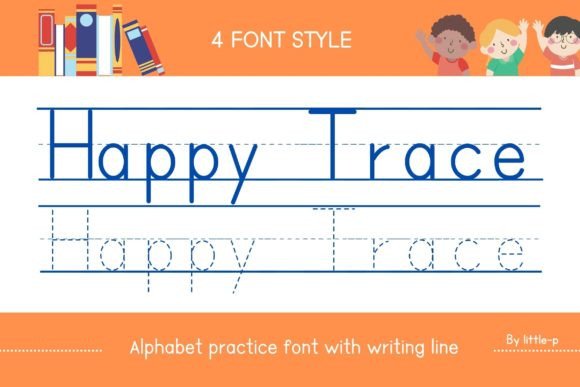
Happy Trace: The Creative Font for Educational Design
A Typeface Built for Learning and Engagement
When you're designing educational materials, you're not just arranging letters on a page—you're shaping how someone learns. The right typeface can make the difference between a worksheet that feels like a chore and one that invites curiosity. That's where Happy Trace enters the conversation. This creative educational font was designed specifically for alphabet practice, and it does something most fonts don't: it builds writing guidance directly into the character set.
Happy Trace is a handwritten font with a warm, approachable personality. The letterforms feel natural and friendly, mimicking the gentle curves and intentional strokes of a teacher's handwriting on a whiteboard. It's not overly polished or clinical, which is precisely its strength. Children and early learners respond to letterforms that feel human, and Happy Trace delivers that quality without sacrificing clarity or consistency.
What makes this typeface genuinely useful is its four distinct styles: Regular, Bold, Letter-line, and Dash-line. Each style serves a specific purpose in the learning process. The Regular and Bold weights handle headings, instructions, and general text. The Letter-line style places letters directly on guided lines, while Dash-line creates dotted letterforms that students can trace over. Together, they give designers and educators a complete toolkit for building worksheets from scratch.
How the Space Bar Trick Changes Everything
Here's a detail that separates Happy Trace from other educational fonts: pressing the space bar generates writing lines automatically. That single feature eliminates hours of manual line-drawing in design software. You type your content, hit space, and the baseline guides appear as part of the text flow. For anyone creating custom worksheets, this is a practical time-saver that keeps your layout consistent and your production process efficient.
This kind of thoughtful design detail reflects a deeper understanding of how educational materials are actually produced. Teachers don't have the luxury of spending an afternoon nudging lines into alignment. Small business owners selling printable resources on Etsy or Teachers Pay Teachers need to produce professional-looking materials quickly. Happy Trace respects that reality.
Where Happy Trace Works Best
The applications for this creative font extend well beyond basic alphabet worksheets. Consider how it fits into different project types:
- Alphabet exercises and handwriting practice — The core use case. Dash-line and Letter-line styles let students trace letters with proper guidance.
- Math worksheets — Number tracing works with the same principles. Use the font for problem headers and guided number practice.
- Cross-subject integration — Combine alphabet practice with science vocabulary, social studies terms, or reading exercises on a single page.
- Printable resources for sale — If you're an entrepreneur building a shop around educational printables, Happy Trace gives your products a polished, cohesive look.
- Classroom materials — Bulletin board letters, flashcards, name tags, and activity sheets all benefit from a consistent handwritten style.
- Branding for tutors and educators — Use the Regular or Bold style for logos, business cards, and social media graphics aimed at parents and students.
For designers working in the education space, Happy Trace functions as both a display font and a practical production tool. It's rare to find a typeface that handles both roles effectively. Most handwritten fonts look charming but fall apart in long-form educational contexts. Happy Trace holds its structure across extended use, which matters when you're setting an entire workbook in a single typeface.
Font Pairing and Design Considerations
Like any premium font, Happy Trace benefits from thoughtful pairing. Because it carries a strong handwritten personality, pairing it with a clean sans serif font for body instructions creates a balanced visual hierarchy. Think of Happy Trace handling the interactive, student-facing elements—the letters to trace, the practice prompts—while a neutral sans serif carries the instructional text that parents or teachers read aloud.
Avoid pairing it with another script font or overly decorative typeface. The visual competition will confuse readers and dilute the educational purpose. The goal is clarity, not typographic showmanship. Happy Trace already brings enough personality; its partner font should step back and support.
When evaluating whether this font fits your project, ask yourself a few practical questions. Does your audience include early learners or students developing fine motor skills? Do you need guided writing lines as part of the text flow? Are you producing materials where a warm, human tone matters more than corporate polish? If you answered yes to any of these, Happy Trace is worth serious consideration.
Licensing, Styles, and Professional Use
Happy Trace is a commercial font, which means you can use it in products you sell—worksheets, activity books, digital downloads, and branded materials for your educational business. Always review the specific license terms before distributing files that include the font itself, but for most creative and commercial applications, it's built for professional use.
The four included styles give you enough range to handle most educational design projects without reaching for additional typefaces. Regular works for standard text, Bold adds emphasis for headers and key instructions, Letter-line provides guided letter placement, and Dash-line creates the traceable dotted characters that form the backbone of handwriting practice. That's a complete system in a single font family.
From a brand identity perspective, using Happy Trace consistently across your educational materials builds recognition. Parents and students begin to associate the friendly, approachable letterforms with your content. That kind of visual consistency reinforces trust—a subtle but meaningful advantage in a crowded market of educational resources.
Making Teaching More Dynamic
The real value of a font like Happy Trace isn't in its technical specifications. It's in the way it changes the relationship between a student and a worksheet. Tracing letters shouldn't feel mechanical. When the letterforms are warm, the lines are clear, and the layout is inviting, practice becomes something students actually want to engage with. That shift—from obligation to interest—is what good educational design accomplishes.
For teachers building custom materials, for designers serving the education market, for entrepreneurs selling printables, and for anyone creating resources where handwriting practice meets thoughtful design, Happy Trace is a typeface worth knowing. It solves real problems, saves production time, and produces materials that look professional without feeling sterile. That combination is harder to find than it should be, and it's exactly what this font delivers.