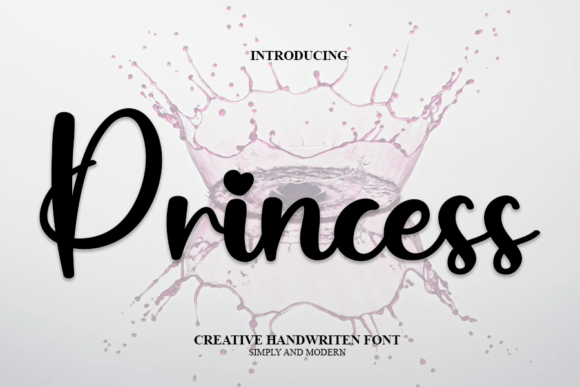
Princess: A Handwritten Font for Designs That Need a Personal Touch
There’s a certain quality to a handwritten note that digital text just can’t replicate. It’s the slight imperfection, the warmth, the feeling that a real person took a moment to create something just for you. In a world saturated with clean, geometric sans serifs and predictable serifs, finding a typeface that carries that authentic, human touch is like striking gold for a designer or brand owner. This is the space where the Princess font lives—a carefully crafted handwritten typeface designed not just to be legible, but to feel genuinely personal.
Princess isn’t a rough, casual scrawl. Think of it as elegant penmanship with a modern, relaxed confidence. The letterforms are delicate yet defined, with a natural flow that suggests a steady hand and a creative mind. There’s a subtle bounce to the baseline, giving words set in Princess a sense of movement and life. It strikes a beautiful balance: it’s sophisticated enough for a wedding invitation but approachable enough for a boutique coffee bag. This versatility is its core strength, making it a powerful tool in your design assets toolkit for projects that demand authenticity and charm.
Where Princess Truly Shines: Real-World Applications
The true test of any creative font is how it performs in the wild, across different mediums and for different audiences. Princess excels in scenarios where you need to bridge the gap between professionalism and personal connection.
In logo design and brand identity, especially for small businesses, Princess can be transformative. Imagine it for a bespoke jewelry maker, a florist, a consultant who values personal relationships, or a children’s boutique. It immediately communicates care, artistry, and a hands-on approach. Paired with a clean, neutral sans serif for body copy, it creates a brand system that feels both polished and deeply human. For packaging design, it’s a standout. Think about product labels for artisanal foods, craft cosmetics, or handmade candles. Princess can make a product feel premium and crafted, telling a story before the customer even reads the ingredients.
For editorial design and publishing, its use is more nuanced but equally powerful. It’s not a font for long-form body text—that’s a job for a sturdy serif or sans serif. Instead, use it for pull quotes, chapter titles, or special section headers in a magazine or cookbook. It adds a layer of visual interest and breaks up the monotony of standard layouts. In the digital realm, web design and social media graphics are perfect playgrounds. A quote graphic on Instagram, a website hero banner for a lifestyle brand, or an email newsletter header set in Princess can significantly boost engagement. It feels native to the social space, cutting through the noise of generic templates.
Making Princess Work for You: Practical Guidance
Choosing a font is a strategic decision. It’s not just about what looks pretty; it’s about what communicates the right message. When evaluating Princess for a project, start with personality alignment. Does your brand or project value warmth, elegance, creativity, and a personal connection? If the answer is yes, it’s worth exploring. If you’re in a field that demands extreme seriousness and traditional authority (like corporate law or finance), it might be better suited for internal, creative materials rather than your primary identity.
One of the most critical steps is testing font pairing. A handwritten font like Princess needs a strong partner to create hierarchy and ensure readability. The classic rule is to pair it with a simple, geometric sans serif (like Montserrat, Open Sans, or Lato) or a clean, modern serif (like Playfair Display or Lora). The contrast is key: the organic flow of Princess provides the accent, while its partner handles the heavy lifting of information. Always test your pairings at the sizes you’ll actually use, checking how they look on both screen and in print.
Check the technical details. What styles and alternates are included? A quality premium font like Princess often comes with stylistic alternates, ligatures, and sometimes even swashes. These features allow you to customize the look further, ensuring your headlines feel unique and not like a default setting. For any commercial use, always verify the licensing. A commercial font license is a necessary investment that protects you legally and supports the type designers who create these valuable tools. Understanding whether the license covers your intended use—be it for a client’s logo, merchandise, or a website—is non-negotiable for professional work.
Finally, consider the context of modern typography. Trends come and go, but a well-crafted typeface with genuine character, like Princess, often has a longer shelf life. It’s not trying to be overly trendy; it’s offering a timeless, human quality. Use it to inject personality into your next project, whether it’s a heartfelt invitation, a compelling brand story, or a social media post that needs to stop the scroll. When chosen and applied thoughtfully, it doesn’t just display words—it conveys feeling.